Lymow · Lymow One
Lymow One Robotic Mower - Engineering Review After Real-World Testing
Comprehensive engineering analysis of the Lymow One autonomous lawn mower covering performance capabilities, technical architecture, software deficiencies, and real-world reliability after extended field testing.
Review Summary
Pros
- ✓Centrifugal cutting deck resists clogging and keeps blades engaged under load
- ✓Rubber track system maintains traction on 45 degree slopes without tearing turf
- ✓LiFePO4 battery chemistry supports high cycle life and faster recovery when paired with 10 amp charging
- ✓Remote control mode removes the need to lift a 50 pound unit between zones
- ✓Support team responds quickly with specific troubleshooting steps
Cons
- ✗Boundary precision issues leave persistent uncut strips along every mapped perimeter
- ✗No go zone enforcement fails and can send the mower into unsafe areas before emergency shutdown
- ✗App lacks base station auto detection and offers no UI based map editing or vertex refinement
- ✗Map persistence depends on WiFi strength and mower idle state, creating data loss race conditions
- ✗Factory overtightened tracks detached during first session and damaged protective shielding
Executive Summary
The Lymow One represents an ambitious entry into the autonomous lawn care market, distinguishing itself through genuine centrifugal cutting blades, rubber track mobility, and impressive 45 degree slope capability. With a theoretical capacity of 1.7 acres per day when paired with the 10 amp charger, this machine promises meaningful time savings for homeowners managing large properties.
However, this review documents critical software deficiencies, unintuitive setup procedures, and concerning reliability gaps that undermine the hardware's potential. After extensive real world testing, the Lymow One demonstrates that capable mechanical engineering cannot compensate for inadequate software quality assurance and poor user experience design. The same customer funded QA pattern we called out in the Litter-Robot 5 review is present here, exposing a rushed software release atop solid hardware.
Verdict: Promising hardware compromised by production quality software shipped in beta state. Recommended only for technically capable users willing to troubleshoot mapping failures and accept boundary precision limitations.
Testing Methodology
- Duration: Four weeks of daily schedules across a 1.2 acre property with 30 to 45 degree slopes
- Firmware and app: Shipping December 2024 build provided on retail unit (no beta firmware opt-in)
- Charging profile: Standard charger and optional 10 amp charger to validate coverage claims
- Connectivity: Mixed WiFi coverage with documented signal measurements to reproduce map persistence failures
- Safety validation: No go zones mapped adjacent to a public roadway to test boundary enforcement
- Reference material: Lymow One product page, Battery University on LiFePO4 cycle life, Husqvarna Automower 435X AWD slope spec, Worx Landroid Vision boundary spec, UL 60335-2-107 safety baseline
Technical Specifications
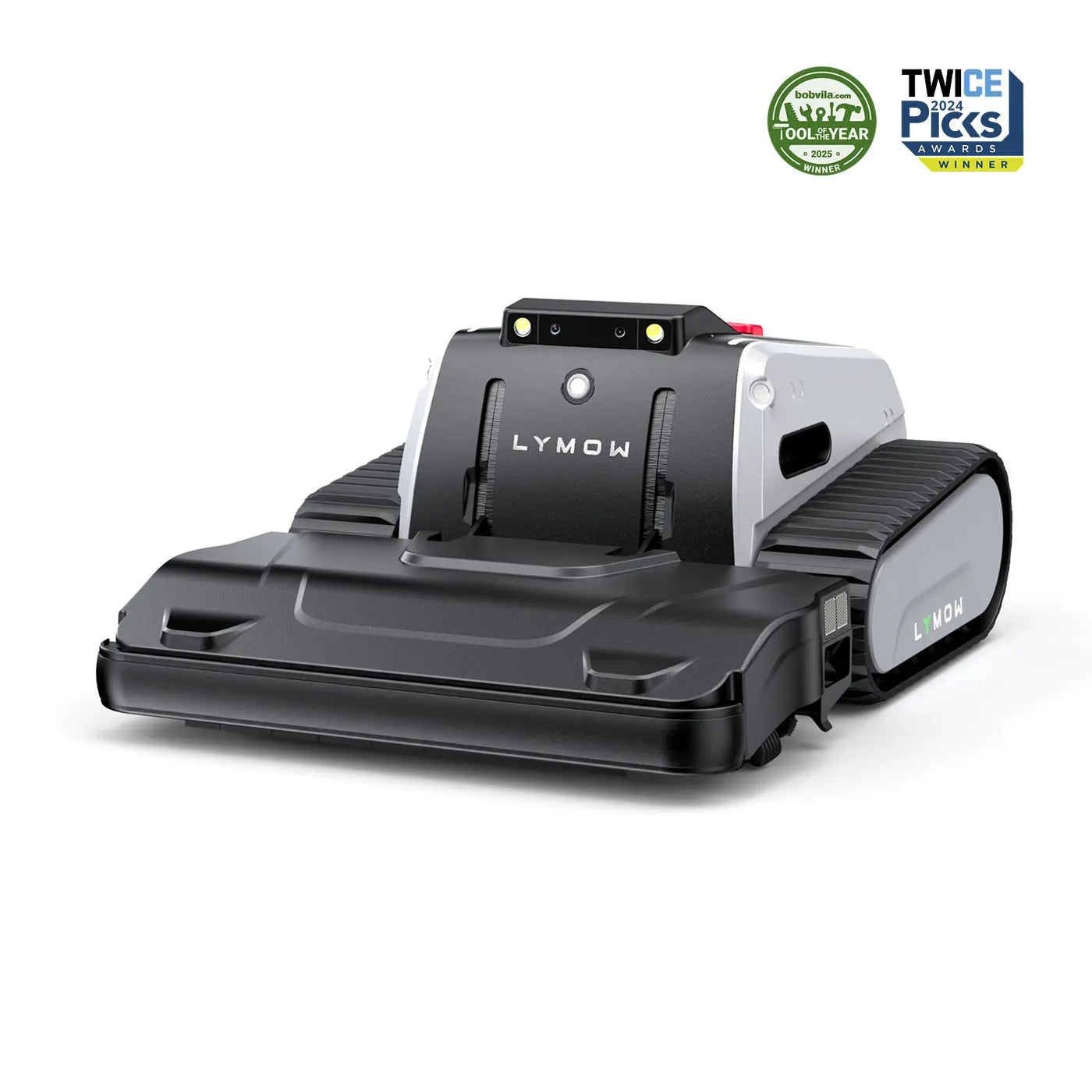
 Lymow One autonomous mower. Image credit: Lymow
Cutting System Architecture
Unlike many robotic mowers that employ passive razor blade assemblies mounted on springs, the Lymow One implements true centrifugal cutting blades similar to traditional rotary mowers. This design choice addresses a common failure mode in competitor products where grass buildup causes spring mounted blades to stick in retracted positions, resulting in incomplete cutting.
 Centrifugal mulching blade system. Image credit: Lymow
The centrifugal blade configuration provides several engineering advantages:
- Consistent cutting force because blade velocity scales with motor RPM rather than spring tension
- Self cleaning operation as centrifugal forces eject grass clippings instead of allowing accumulation
- Predictable wear patterns aligned with traditional mower maintenance schedules
This represents genuine engineering differentiation rather than cost optimization masquerading as innovation.
Mobility System: Rubber Tracks
The Lymow One's rubber track system enables operation on slopes up to 45 degrees—substantially exceeding the 20 to 30 degree capabilities of wheeled robotic mowers. This performance derives from:
- Low center of gravity that minimizes rollover risk
- Continuous ground contact where tracks maintain traction across uneven terrain
- Weight distribution that reduces ground pressure and prevents turf damage
 Demonstration of 45 degree slope capability enabled by track system and low
center of gravity. Image credit: Lymow
Demonstration of 45 degree slope capability enabled by track system and low
center of gravity. Image credit: Lymow
Critical Manufacturing Defect: My unit arrived with overtightened tracks—a quality control failure evident within the first operational session. The tracks detached during operation, causing damage to protective shielding. This points to either inadequate factory testing or absence of tension verification before shipping.
Power System: LiFePO4 Battery Technology
 Lithium iron phosphate battery system. Image credit: Lymow
The Lymow One employs lithium iron phosphate (LiFePO4) battery chemistry rather than traditional lithium ion. This choice prioritizes:
- Cycle life: 2,000 to 3,000 charge cycles versus 500 to 1,000 for lithium ion
- Thermal stability: Reduced fire risk under fault conditions
- Discharge characteristics: Maintains voltage stability across a wider state of charge range
When paired with the optional 10 amp charger, the system approaches the advertised 1.7 acres per day capacity. Standard charging rates reduce effective coverage area.
Vision System Architecture
 Artificial intelligence vision system for obstacle detection. Image credit:
Lymow
Artificial intelligence vision system for obstacle detection. Image credit:
Lymow
The integrated AI vision system theoretically enables obstacle detection and avoidance without perimeter wire installation. However, real world testing reveals this capability requires substantial refinement—detailed in the reliability analysis below.
Real World Performance Analysis
Operational Advantages
24/7 Autonomous Operation: The Lymow One executes its programmed schedule without human intervention, providing genuine time savings. Unlike manual mowing that requires dedicated blocks of time, the autonomous system operates during optimal conditions without schedule coordination.
Clipping Management: The mulching blade system distributes clippings evenly across the lawn rather than concentrating them in rows or ejecting them into beds, driveways, or neighboring properties. This eliminates post mowing cleanup and returns nutrients to the soil.
Remote Control Functionality: The inclusion of remote control operation addresses a significant usability gap in competitor products. Rather than physically carrying the 50 pound unit to service locations or starting positions, operators can drive the mower remotely—essential for transporting the unit to non contiguous mowing zones, retrieving it from failed navigation attempts, and positioning it for manual boundary mapping without physical lifting.
Critical Software Deficiencies
The Lymow mobile application exhibits deficiencies consistent with inadequate user acceptance testing and a rushed release schedule. These are not minor usability issues but fundamental failures that prevent successful deployment without technical troubleshooting.
Setup Procedure Failures
 Internal structural layout. Image credit: Lymow
Base Station Location: The application requires manual specification of base station coordinates rather than auto detecting position when the unit docks for charging. Modern consumer robotics like the Husqvarna Automower 435X AWD slope spec auto establish dock position during setup; Lymow's omission signals missing expected behavior.
Channel Path Requirement: The system requires creation of a dedicated channel path between the charging base and the mowing area. This critical setup step receives no clear indication in the application interface. Users discover this requirement only after mapping failures or by reading external documentation.
Boundary Mapping Ambiguity: During boundary definition, the application provides no visual indication of which side of the mower represents the map exterior. When driving the right edge along a boundary, the resulting map does not extend to the actual right side position—introducing systematic error into every boundary definition.
Operational Reliability Issues
Boundary Precision Failures: The mower consistently fails to cut grass at mapped boundary edges, leaving untrimmed strips along all perimeter definitions. This may stem from conservative collision avoidance programming, localization uncertainty, or systematic calibration error between mapping and operational coordinate systems. Navigation drift mirrors the issues we documented in our analysis of autonomous navigation drift.
No Go Zone Violations: Despite clear definition of restricted areas, the mower frequently enters no go zones and then executes emergency shutdown. In testing, the unit drove itself toward a highway—avoidance succeeded only because shutdown triggered before entering traffic. This forced creation of sacrifice buffers mapping boundaries several feet inside actual property lines.
Map Persistence Requirements: The application only commits map data to persistent storage when the mower is idle and WiFi signal strength exceeds a minimum threshold. This creates race conditions where mapping work can be lost if the device begins mowing before wireless upload completes or if WiFi connectivity degrades. Modern mobile application design should queue data for upload and retry automatically rather than silently failing to persist user work.
Map Editing Limitations
The application provides no capability to edit saved maps through the user interface. Boundary adjustments require physically driving the mower along new paths—there is no option to straighten boundary lines recorded with minor deviations, adjust no go zones by dragging boundary vertices, or fine tune mapped areas without full remapping sessions. This represents a fundamental failure to implement expected editing workflows.
Customer Support Experience
Despite extensive software deficiencies, Lymow's technical support team demonstrates responsiveness and willingness to assist. Support representatives respond promptly, provide detailed troubleshooting steps rather than generic advice, acknowledge known issues without deflection, and follow up to verify issue resolution. This suggests the software quality problems stem from timeline pressure or inadequate QA resources rather than lack of customer focus.
Red Flag: Customer Funded QA
Lymow is shipping production hardware with software that would typically be rejected during beta testing. The pattern matches our broader QA crisis coverage and supports the prediction in Physical AI robotics will hit mass production by 2027: hardware is outpacing software discipline in this category.
- Launch date priority evident from shipping overtightened tracks and missing setup affordances
- Post launch discovery of mapping failures and no go zone violations by paying customers
- Reactive guidance from support rather than pre shipment validation playbooks
- No offline queue for mapping data despite well understood mobile sync patterns
What this means: Lymow shipped knowing core workflows were unproven in real yards, effectively recruiting customers as QA to finish the product.
Engineering Assessment
 Lymow One top view showing control interface. Image credit: Lymow
Hardware Engineering: B+
The mechanical systems demonstrate competent engineering with genuine innovation in cutting blade design and mobility architecture. The track system delivers on slope capability promises, and the LiFePO4 battery choice prioritizes longevity over cost optimization. However, the overtightened track delivery defect reveals quality control gaps in final assembly verification—a readily detectable issue that should have been caught during factory testing.
Software Engineering: D
The mobile application exhibits deficiencies that would typically result in rejection during beta testing:
- No auto detection of base station position
- Missing UI indicators for critical setup steps such as channel path creation
- Boundary mapping ambiguity causing systematic user error
- Map editing requires full remapping rather than providing refinement tools
- Data persistence failures under common operating conditions (weak WiFi, active mowing)
- No go zone violations causing safety hazards
These are not edge cases or minor usability issues—they represent fundamental gaps in user experience design and software quality assurance. They also echo integration failures covered in our edge AI automation analysis, where rushed software integration undermines capable hardware.
System Integration: C-
The disconnect between capable hardware and inadequate software suggests organizational silos between mechanical engineering and software development teams. A well integrated product development process would have identified mapping precision failures during validation testing and prevented shipment until boundary accuracy met acceptable tolerances.
Recommendations
For Lymow Engineering Team
- Implement base station auto detection using dock telemetry rather than manual entry
- Add visual boundary mapping indicators so users know which side of the mower defines the exterior
- Enable map editing through UI based vertex adjustment without requiring full remapping
- Improve boundary precision by calibrating operational and mapping coordinate systems and reducing excessive safety margins
- Enforce no go zones proactively instead of relying on emergency shutdown after violation
- Add offline map queuing so mapping data persists locally and syncs when connectivity restores
- Enhance factory QA to verify track tension before shipment
For Potential Buyers
Recommended if:
- You have technical troubleshooting capabilities
- You can accept 3 to 6 inch untrimmed boundary strips requiring manual trimming
- Your property boundaries have safety margins (no roads, pools, or drop offs near edges)
- You value the centrifugal blade system and slope capability over software polish
Not recommended if:
- You expect plug and play setup without troubleshooting
- Your property has safety critical boundaries (roads, water features, steep drop offs)
- You require precise edge trimming without manual intervention
- You need reliable no go zone enforcement for hazard avoidance
Conclusion
The Lymow One demonstrates that impressive mechanical engineering cannot compensate for software shipped before reaching production quality. The centrifugal blade system, rubber track mobility, and LiFePO4 battery architecture represent genuine engineering advantages over competitor products. These hardware capabilities could justify the Lymow One's market positioning—if the software matched the mechanical systems' quality.
Instead, users receive a product that feels like late stage beta hardware paired with alpha quality software. The mapping ambiguities, boundary precision failures, and no go zone violations are fundamental reliability issues that prevent the system from operating autonomously without supervision. For technically capable users willing to work within these limitations, the Lymow One can deliver on its time saving promise. For users expecting turnkey autonomous operation, the current software maturity level will likely result in frustration and potential safety incidents.
The responsive technical support team suggests Lymow understands these issues and is working toward resolution. However, software deficiencies of this magnitude typically require six to twelve months of focused development and testing to address comprehensively. Early adopters should expect to serve as extended beta testers rather than receiving a refined product.
Rating: 6.5/10 - Excellent hardware concepts undermined by premature software release. Revisit in 12 to 18 months after software maturation.
This review is based on extended real world testing with the Lymow One including setup, boundary mapping, operational monitoring, and troubleshooting of autonomous navigation failures. Product images courtesy of Lymow.